
Types of Russian Visa and Invitations
Types of Russian Visas and Invitations
There are 6 main types of Russian visas: a tourist visa, a business visa, a student visa, a personal visa, a work visa, a transit visa - each type corresponds to the purpose of your visit. However, many people come for a short business trip with tourist visas, and many people come to visit their friends with business visas. So, when choosing the type visa, the only consideration should be your convenience in terms of price of the visa, its speed of processing, the period of stay this visa allows and the number of entries the visa allows. Especially, as Russian officials seem not to care about which visa you finally take, what matters is how much you pay... However, when filling in an application form in the field "purpose of your trip" you should specify the purpose corresponding to the type of your visa. If you apply for a tourist visa, specify "tourism", if you apply for a business visa, specify "business meetings" or "seminars", if you apply for a private visa, specify "visiting friends". (according to Fed. Law #114-FZ, Ch.4, A.26 - see above).
The invitation (also called visa support) is a special document issued by the party that invites you to Russia. The invitation is required by a Russian consulate to be able to process your visa. For every type of visa, there exists a different type of invitation (tourist, business, work, private, student).
Need a Russian Visa? Order online, no reservation ties, ready in 24 hours:
click to load the russian visa application form
Russian Tourist Visa
This type of visa is issued for the travelers who come to Russia for tourism purposes. This visa is easiest to get and the least expensive of all visas, so it's ideal for tourists. A tourist Russian visa is single-entry or double-entry only and can be valid for the period up to 30 days. If you are a US citizen, you can get a tourist visa to Russia valid for 3 years, and you can stay every 90 out of every 180 days on that type of visa. It usually takes the Russian consulate from 1 to 10 days to issue this type of visa and will cost from $50 US to $150 US, depending on the time of processing.
The price of a tourist invitation is usually $25 to $40 US, and it takes 1 hour to 1 day to issue it. It is usually sent to the applicant by fax, by e-mail (scanned copy), or by post (if the Russian consulate requires originals).
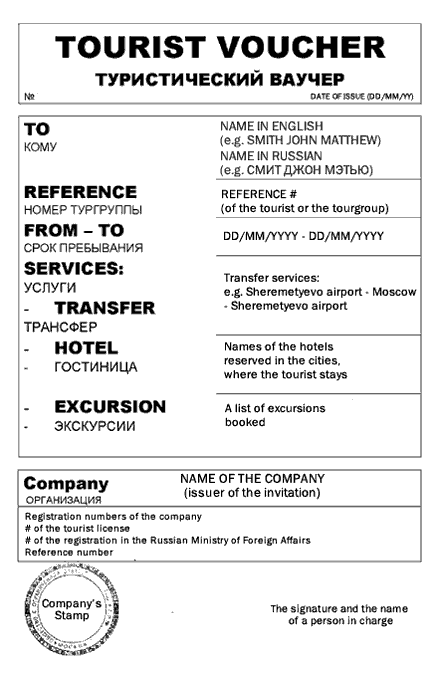
And your reservation confirmation will look something like this:
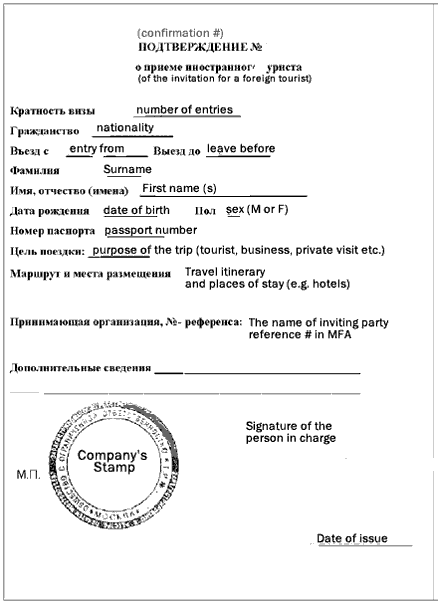
Also, be sure to fill in the visa application form after you received your invitation, and specify there the same data as in the invitation: the name of the inviting travel agency, the purpose of the trip - tourism, the visa dates, the cities to visit.
If you got a tourist invitation but write that the purpose of your trip is to visit friends, you will be refused a visa, because you need a different type of visa to visit friends (private).
Where can one get a tourist invitation?
Basically, the tourist visa support issued by travel agencies is the same tourist voucher and reservation confirmation, meaning that technically you have a reservation at a hotel. Practically, you don't have to stay in that hotel and may stay where you want. Of course you have better chance of getting a visa if you show the consulate that you're going to stick to your "original plans" and if the information you provide in the visa application form is consistent with the information provided in your visa support (especially, the purpose of your trip - tourism, the place of stay - hotel, etc.).
Most consulates accept copies of the tourist invitation. So you can receive it by fax or e-mail (scanned copy) and bring it to the consulate. There are some consulates that may require originals. For the latest list of those "problematic" consulates, see our Russian Visa Insider's Page.
After you come to Russia, you need to register your visa in 72 hours (see Registration section). If you stay in a hotel, it must register your tourist visa for the whole period of your stay (according to Decree #212 - 26 Apr '91), the hotel registration costs about $0.5 (16R). If you stay in an apartment or with your friends, the landlord (the owner of the apartment) should fill out a special landlord letter and submit it to immigration authorities via the post. Read more about it on our Russian visa blog.
You can apply for a tourist invitation online through our website and we'll refer your request to our partner travel agency. This agency has a reference number in the Russian Ministry of Foreign Affairs and offices in Moscow and St. Petersburg, so you can have your visa registred easily when you arrive. The tourist visa support costs $30 US (taxes included, no additional services required) and is ready in 1 working day. If you're interested, please just fill out our Russian Visa Support application form.
Need a Russian Visa? Order online, no reservation ties, ready in 24 hours:
click to load the russian visa application form
Russian Business Visa
This type of visa is supposed to be issued for the people, who come to Russia for business purposes. But because this type of visa allows long stays, multiple entries etc., it is also used by ordinary travelers, who need more flexibility.
A way around the 90 days staying rule is to get 3-month business visas and to do a visa run every 3 months to a country outside of Russia where you can get a new visa. You should be aware that Russian consulates in most countries only give visas to the people who have a permit of residence in the country the consulate is located. So, say, if you are a US citizen and go on a visa run to Estonia, you might not get a visa there unless you have a residence permit in there. However, all EU citizens have the right to live in any EU country, so if you are from UK, then you can go anywhere in Baltics to renew your visa.
Another option is to get an official working visa (you'll need to find an employer who has a quota for foreign workforce). You may also find a language school or a university and try to get a long visa through them.
It takes approximately the same time for the consulate to issue a business visa as a tourist visa, but a business visa is slightly more expensive. The price depends on the processing speed, usually, it's about $80-$90 US for 5-7 days, and about $150 for 2 days. You can get the exact quotes at the Russian consulate where you apply.
To obtain a business visa, you need a business invitation. Contrary to a tourist invitation, which is issued by a Russian travel agency, a business invitation is issued by the Federal Migration Department (UFMS). The applicant's data can be submitted to the UFMS either by a business registred in the UFMS or a travel agency. Usually, a company that would like to invite a foreign person for business, requests such service from a travel agency (registred in UFMA). The travel agency submits all travel data of the person to the UFMA, pays a certain processing fee, and after a few days (depending on the processing fee) receives the invitation. After that, this invitation can either be sent to the person invited by post (if the consulate requires originals only), by fax (a copy), or by e-mail (a scanned copy). There used to be a possibility to have a telex sent directly to a Russian consulate, but now it's only available in exceptional cases.
Where can one get a business invitation
As you understand, any foreign person can apply directly to a Russian travel agency for such invitation. So, if you're coming to Russia for travel and want to get a business visa only because you would like to stay longer and to be able to enter or leave multiple times, you can apply for a business invitation through a travel agency.
It's better to fill in the visa application form after you received the business invitation and to specify there the same data as in the application (the same inviting company, the same visa dates, the same cities to visit).
The price of a business invitation depends on the processing speed and the number of entries. For example, a 3-month double entry invitation would cost about $90 US, and a 12-month multiple entry invitation would cost about $250 US.
A copy of business invitation will be accepted by most consulates if you apply for a single- or double-entry visa. If you require a multiple-entry visa, the consulate will require originals. Russian consulates in some countries always require originals, for the latest info on these, see our Russian Visa Insider's page.
After you come to Russia, you should have your visa registered in 72 hours. If you stay in a hotel, it must register your visa for the whole period of the visa, but not longer than 3 months (Decree #212, 26 Apr '91). If you stay in an apartment or with friends the landlord should register the visa. The process is explained in detail on our Russian visa registration blog post.
You can apply for a business invitation online through our site. Your application form will be automatically referred to our partner agency. This agency is authorized to issue business invitations by the Federal Migration Service and has offices in Moscow and St. Petersburg center. You can see the prices and apply for the invitation at our Russian visa support order form.
Need a Russian Visa? Order online, no reservation ties, ready in 24 hours:
click to load the russian visa application form
Student Visa
This type of visa is issued only for students, who come to Russia for exchange or education.
Usually, the student visa doesn't have a limited validity, it is extended all the time, depending on how long you study.
When you apply to the consulate for a student visa, you'll need to pay a normal fee, which will be about the same as for a tourist visa ($50-$150, depending on processing time).
It should be noted that because of change in the Russian law in October 2007 many expats found out they can't stay longer than 90 days in a 180-day period in Russia. In such situations, getting a student visa might help, but you should know that it's illegal to work on a student visa.
Personal / Private Russian Visa
To obtain this visa, you need a personal invitation certificate (or visa entitlement certificate - "izveshchenie") from a person living in Russia. Sorry, but it will be a real pain in the ass for your friend to make this invitation certificate for you. This person should go to a local OVIR office (something like immigration officials), stand in a long queue, get an application form, fill it in, pay a processing fee (about $30 US - always changing), and wait for about 45 (!) days until the immigration officials will check him (the person who's inviting you) and you. I don't know what they check, but I guess they're looking for some serious stuff like terrorism or spying -- there's no other reason for it to take 30 days. I even think they'll quiz Interpol and the FBI about you too...
So, after all this is finished (hopefully with success), the UVIR officials will give your friend an invitation (after he stands in a long queue again). This invitation can only be sent to you by post, because consulates accept originals only. It can't be faxed or e-mailed or telexed. So, all in all, it'll take about 14 days for it to arrive by post (or 1 day if it's sent by express post, but then it'll cost $50 or so). Then you can take it along with other documents needed to the consulate, and apply for your private visa. It'll cost you the same as the other ones, but will surely cause much suspicion from the consulate officials. Why would a Russian person invite a foreigner to his country? Only to sell his motherland's secrets...
So, I think you understand why most of the people prefer getting a tourist or a business visa instead...
Need a Russian Visa? Order online, no reservation ties, ready in 24 hours:
click to load the russian visa application form
Short 72-Hour Visas
This type of visa WAS an experiment started on the 1st February, 2002 to attract more tourists to Russia. However, there are canceled as of now, so it is NOT possible to get a 72 hour visa at the moment, it's better to go for a tourist visa.
However, if you are traveling on a cruise ship, the cruise company should be able to provide you with a short visa, usually valid for up to 72 hours.
You can also get a transit visa for 72 hours, no invitation is needed (see the info below).
Update – Important if you're visiting a sports event: A special law has been signed by Russian parlament, that allows the president to let foreigners in without a visa for a short period of time with a special decree. It will be used for one-off sport events mainly, such as winter Olympic games in Sochi in 2012. However, it has already been used for the Final Cup soccer series in May 2008 when the president waived visas for football fans who had a valid ticket for the game. The ticket needed to be presented instead of the visa at the border and allowed a 1-week visa-free stay (17 to 25 May). So it's quite restrictive in the way that you can't really freely travel around the country. But a good option if you're just going to see a sports event – no need to get an invitation.
Russian E-Visa
Since October 2019 citizens of EU can visit St. Petersburg and St. Petersburg region on a special e-visa for Russia, which is issued as an electronic document and is valid for 8 days maximum. You don't have an invitation or visa support for this type of visa, however, the territory of your travel is limited. A special type of e-visa is also available for Kaliningrad region.
If you are a citizen of Japan, China, Hong Kong, and some other Asian countries, you can also visit the Far East (Vladivostok, Kamchatka, Sakhalin) on the e-visa. Learn more on our Russian e-visa page.
Transit Visa to Russia
This type of visa is usually given for maximum 72 hours if you're crossing the country or need to change the airports. The requirement and the prices depend on the country you're in, so the best thing to do is to contact the Russian consulate and they'll explain everything.
The most common requirements are
1) a valid travel document (passport);
2) onward airline or train tickets (proving you're crossing Russia and will not stay for longer than 72 hours).
3) a visa to the country you are traveling from Russia (if you need one)
4) completed visa application form
5) one passport-size photograph
The price of the transit visa is usually lower than a normal tourist visa, for example, in France it costs 28 Euro. Note, that you don't need to obtain an invitation or visa support to get this type of visa.
Russian Visas for Cruise Passengers
Work Visas for Russia
Work visas are given to foreigners who have an official employment contract in Russia. It's a very long process to get one and only the companues that have quotas to employ foreigners can apply for it. However, such visa allows you to stay as long as you need in Russia (unlike business visa which only allows a maximum of 90 days within a 180-day period and which doesn't give you the right to work in Russia).
In order to get a work visa, you should find an employer first. After you found an employer, they should get a work permit for you and write you an invitation letter. After you have these documents, you can apply for a work visa in a Russian consulate. Beware of companies offering work visas online. The only visas you can officially get online are the tourist and business visas. If you need to stay in Russia longer than 90 days within a 180-day period and to be officially employed, work visa is the only legal way to do so. If you don't need to be officially employed, you can get a student visa or get a few 3-month business visas, one after another.
Need a Russian Visa? Order online, no reservation ties, ready in 24 hours:
click to load the russian visa application form
Most Recent Articles:

How to Get a Russian Visa: Step by Step Guide

Russian Visa Application Form
