
 |
|
Going Out & Sightseeing in Rostov
Below
is a tour around Rostov, that'll let you see all the main sights
of the town in 4-5 hours.
Most probably, the first
thing you'll see when you arrive in Rostov Veliky is its concrete
railway and bus stations' building, situated a bit outside of the
centrum. To get to the centrum of the city you need to take the Lunacharskogo
(Луначарского) street, that leads from the station to the
Kremlin. It's better to walk along this street to get the first impression
of Rostov: rustic calm provincial town, with low wooden houses, each
made in a different way. After 10 minutes of walking straight ahead
you'll reach the central street of the town, very alive Karla Marksa
(Карла Маркса), where various shops are nested in old simple buildings
and restoration works are taking place. If you turn right, walk ahead,
and then turn left, you'll get to the western gates of Rostov's Kremlin.
ROSTOV KREMLIN.
The place where the Rostov Kremlin situated is the core of Rostov,
not only because of the famous sight, but also because it was this
place, where long time ago the Finn-Ugor 'Merya' tribes founded their
first setllements, which preceded the old town of Rostov. In
the 19th-20th century there were archelogical researches on the terriory
of the Kremlin, and many items and things found, exhibited now in
the Archelogy museum of the Kremlin. Among the findings are
the old drakkar's parts, ancient tools and items that were used by
pre-historic people, by the Meryas and the Slavs. The archeology museum
is on the right of the west gates of the Kremlin, opened 10 to
17 daily, admission 15 r - $0.5.
The Kremlin itself is not old, judging by Russian measure, the majority
of the buildings inside were built in the 17th century. The Kremlin
was never supposed to protect the town: its main function was to be
the residence of the local head of church, so it was skillfully decorated,
rather than fortified. Now the Kremlin is divided into three parts:
Cathedral square (Sobornaya ploshchad), Bishop's court (Arkhiereiski
dvor) and Metopolitan's garden (Mitopolichy sad).
The main cathedral of the Kremlin and of the town, located on Sobornaya
square is the Assumption cathedral (Uspensky sobor - Успенский
собор), that was built in 1508-1512. Actually, it was not the first
Assumption cathedral elevated at this place, the first one was wooden,
then a new cathedral was elevated made of white stone, and only in
the beginning of the 16th century the Assumption cathedral you see
now was built (on the photo below).
The cathedral looks very nice with its white facads and wooden domes,
especially that it's not completely restorated, so it's preserved
the ancient appearance.
You can get inside the cathedral through the northern gates of the
Kremlin (from the inside), or through a small church shop facing Karla
Marksa street. The cathedral is opened from 9 to 17, but you can also
get inside the Sobornaya square (where the cathedral is located) after
17.
Next to the cathedral there's a bell-tower, built in 1680s.
On top of the bell-tower you can see 15 bells, that were also made
at that time. The heaviest bell (on the left) called 'Sysoi' weighs
more than 32 tonns and required much space, so the additional tower
on the left of the bell-tower was elevated. Sometimes the monks let
people climb up the bell-tower, so you can touch the bells
and see Rostov and its Kremlin from high. When we were in Rostov,
there was a goup of tourists and their guide wanted them to climb
the bell-tower. The monks didn't want to let anybody in (especially
that everything was already closed, it was 6pm), but the guide arranged
that every member of the group pays 5 roubles ($0.16), and the monks
let everybody in. So, if you want to climb the bell-tower so much,
you can offer something to the monks (I think around $2 will be enough,
no matter how many people there are).
The central part
of the Kremlin, bishop's court, started in the 17th century.
One of the first buildings was the Ascension church (Voznesenia
tserkov) (on the photo below), above the northern gates (that lead
to the Cathedral square). It was
in this church, where for the first time in Russia the altar-screen
(iconostas) was made out of stone (before they were making it of wood).
Opposite to the church, on the other side of the bishop's court there
are Metropolitan's chambers.
The walls and the towers (on the photo on the right) of the
Kremlin were built in 1680s didn't have any military significance,
even though they could be used for protection. Their main purpose
was decorative.
One of the latest Kremlin's buildings is the gate-church of John the
Divine (Ioanna Bogoslova church), built in 1683 in the best traditions
of Russian architecture of that times.
AROUND
KREMLIN.
In 1630s the ramparts were elevated around the
Kremlin, designed to protect the town from invasions. At the south-east
part of the rampart there's a working Rozhdestvensy convent,
and if you walk along the eastern side of ramparts to the north,
you'll see Ascension Church (Voznesenia tserkov), built in
1566 after Ivan the Terrible's decree. There are richly decorated
Tsar's gates (Tsarskie vrata) and some interesting frescoes inside,
made by fresco-painters from Yaroslavl in 1570.
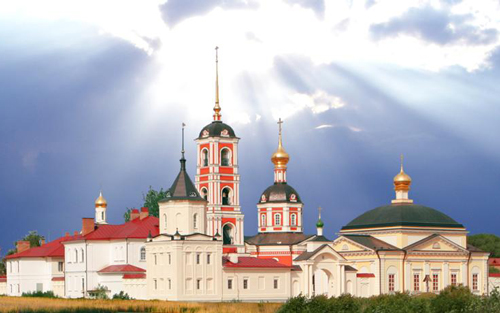
At the western part of the town, on the shore of Nero lake, there's
the Monastery of Jacob Saviour (Spaso-Yakovlevsky monastery)
(on the photo on the left), founded in the 14th cenury. The monastery
looks especially magnificient from the shore of Nero lake next to
the Kremlin. You can take a boat to the monastery for around 100 r
($3.5) there, or walk for 25 minutes. The majority of the buildings
inside the monastery were built in the 17th century. The first cathedral
of the monastery was Zachatievsky cathedral, first built in 1686,
but altered since then.
|
|