
How to register a Russian visa, Russian visa registration laws
Need a Russian Visa? Order online, no reservation ties, ready in 24 hours:
click to load the russian visa application form
What is a Registration
Visa registration is a relic of the past dating back to the Soviet time designed to make sure you're not going to occupy the valuable Russian soil without authorities' permission.
Need a Russian Visa? Order online, no reservation ties, ready in 24 hours:
click to load the russian visa application form
Where and How to Register Your Russian Visa
If you're staying at a hotel:
If you are staying at a hotel, the hotel must register your visa (according to the Federal Law #115-FZ, Article 24). The hotel administration will ask you for your Russian visa, passport, and migration card (which was given to you at the Russian border). A small registration fee can be imposed (from $0.5 US to about $5 US) and normally it takes from a few minutes to a day to have your visa registered.
If you're staying at a hostel, they'll most likely register your visa only if it was issued with them. It means that if you want to be more flexible in choosing where you live, it's better not to get your visa through hostels, because then you'll be obliged to stay there at least for one night, othewise they won't register your visa. The reason is that hostels in Russia don't issue the invitations themselves, but do it through affiliate travel agencies, that's why the travel agency rules apply to them as well (see below).
Need a Russian Visa? Order online, no reservation ties, ready in 24 hours:
click to load the russian visa application form
If you're staying with friends or renting an apartment:
According to the new rules any Russian citizen with "propiska" (registration) can register a foreigner at his/her apartment at a local police station or any post office. The whole procedure takes about an hour (because of the forms you need to fill out and queues) and costs about €5. You can also use a travel agency that issued your visa, but they will basically have to do the same: find a person who has a flat in the city you're in and have them register you on their address. That's why you'll pay €20, not €5 (because someone else will have to queue and get paid for it :)
Here's how the registration is done now (based on our personal experience)
The Russian person who's registering a foreigner at his/her address should go to any post office or the local police station. The foreigner doesn't have to be present. For example, if you're in Moscow, you can try The Central Post Office on metro Chistye Prudy (intersection of boulevard ring and Myasnitskaya st.)
1) Get the copies of the traveller's first passport page, Russian visa, and migration card. These can be done at the at the post office. The copies cost about 25 R (€0.70).
2) Go to the department of the post office, which deals with "recorded" delivery. In our case, it's another entrance a bit further along Myasnitskaya st. to the left under the arch and then to the right.
3) Ask them to give you the foreigner registration form ("migratsionnaya forma"). You need to fill out two copies ALL in Russian.
4) Get a special paper, which lists all the documents you'll be sending off (called "Opis").
5) Find the address of the Local Migration Office, which is responsible for the area where the landlord is registered. There's a list of them at the central post office UFMS (Federal Migration Service). For example, my apartment where I have registration is in Izmailovo (east Moscow), so I had to write the address of Izmailovo Migration Service on the envelope. You can see a list of all Moscow UFMS here: http://www.fmsmoscow.ru/otdelenija.php
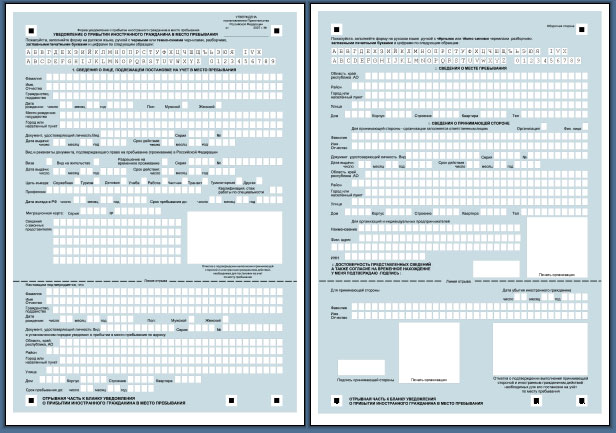
6) Once that is done, the landlord should present all the forms to the post office clerk. They will check everything and give you back a part of the migration form stamped. It's a proof that it's been sent and can be shown to police when they check for the registration. We had to pay 150 R (€4 to send everything off to the migration service). The whole procedure took about 1 hour -- too many forms and queueing but perhaps you can find a post office that's less busy. Also, below is the migration form which you can use to fill out so it'll save you some time. The registration can also be done directly at your local UFMS (police station), but the post office option is somehow better, cause you can use any post office in the country and also because the queues at UFMS are usually much longer.
Need a Russian Visa? Order online, no reservation ties, ready in 24 hours:
click to load the russian visa application form
What if You Don't Register Your Visa
I wouldn't bother writing all that if it was ok not to register your visa. But it's not. You might have problems with the police (if they stop you to check your passport).
The fines that you might pay (about $50-$100 US) in both cases are higher than the registration fee. In the worst case, you may even be deported from Russia. If you were deported, you wouldn't been able to enter Russia for 5 years after the deportation.
So, we strongly recommend you to register your visa in 72 hours (only working days count) upon arrival. If you have any problems with registration, don't let it go, read the information below, it should help you to solve them.
Also it's always better to know how far your rights extend to, so below I also provide references (and short descriptions) to some Russian visa registration laws, which might be useful if somebody wants to take advantage of you.
Recent reports suggest that if you were fined twice for breaching the Russian visa registration rules, you significantly lessen your future chances of getting a Russian visa (for 5 years).
Also, one important thing to know is that because it's the responsibility of the accommodating party to register your visa, they will get in even more trouble than you would because of not registering your visa. If it's a hotel, they won't only be fined, but may lose their license. If it's a host, they will be fined too and in case they're renting an apartment they might also be prosecuted for tax evasion or something like this. So it's in their interests to register your visa and avoid any problems with authorities.
Need a Russian Visa? Order online, no reservation ties, ready in 24 hours:
click to load the russian visa application form
Problem #1: Can't Find Where to Register
Description: What if you're not living in a hotel and the agency that issued the invitation for your visa doesn't have an office in Russia?
Reason: This situation may happen if you made your tourist or business invitation through a company that doesn't have an office in the city you're in, and you decided not to live in a hotel, but to live in an apartment or with your friends. It's not a big problem.
Solution 1: Actually, you are supposed to be registered NOT by the agency, but by the people you're staying with. So have them go to any post office or a local police station, fill out the form, and register you there. The agency doesn't have anything to do with it.
Solution 2: Contact the travel agency, explain the situation, ask them what to do. Most probably, they'll give you the address of the local police station / post office where your host can submit your registration to the authorities.
Problem #2: The Landlord Doesn't Want to Register You
Solution 1: Tell the landlord that if they don't register you, they would get fined and in case it's a hostel / hotel they might lose their license. This is what the law says and you can tell them about it clearly. Also, if the landlord is afraid of the tax police, you can tell them that one person won't do a difference (as they probably never register foreigners in their apartment anyway).
Solution 2: Find a friend to register you at their address or ask the landlord to do that for you.
Problem #3: Losing Documents
Solution (in 6 steps):
1. Go to any police station around the area where your passport was lost and get a special paper, which says that your passport was indeed lost (it's called "spravka" in Russian).
2. Make sure you still have your planeticket with the date of return. If you don't, book a new flight and get the printed confirmation of booking.
3. Make some passport size photos on a special paper (not shiny) - available in any photo places.
4. Go to your embassy to get a new passport (you should contact the embassy just after you lost the passport to start processing).
5. If you have a copy of your lost visa it's better.
6. Take all the documents and papers listed above (the spravka from police, your plane ticket, photos, new passport, copy of your lost visa (if you have one)) and take it to the office of the travel agency that issued your visa support. Usually, it's the same office where you had to make your visa registration. You will be fined about $150 US by immigration officials and, if everything will go allright, you'll be given a new visa in a few days.
Problem #4: Police Scams
There's nothing horrible or frightening in being stopped, it's normal. Some cops will care if you don't have a registration, some won't. If a cop stops you to check your documents and you don't have a registration, he has a right (according to the Russian law) to take you to police station and to fine you. He doesn't have rights to detain you for longer than 3 hours (except special cases), or to deport you from Russia (this is done by court decree only).
From my own experience, police never stops or checks women, especially foreigners.
The problem is that sometimes cops use the registration regulation to make money on it. A cop stops a foreigner on the street, checks his passport, sees that he doesn't have a registration (even if 72 hours haven't passed yet) and says something like: "Ok, big problem, pay hundred dollars or go prison". Clearly, this is a real crap, they just want a bribe. If you want, you can pay him a bribe, or you can show them that you know your rights and they'll leave you alone.
Your rights: If less than 7 working days have passed since you arrived in Russia (or in any Russian city) - excluding holidays and weekends - you have not broken any regulations and laws, so you don't even have to pay any fines.
If more than 7 working days have passed, and you haven't registered your visa, then it is considered that you made an "administrative infrigement" and you're subject to the Russian administrative codex regulations. The new Russian administrative codex, which became effective on the 1st July 2002 is implemented by the Russian Federal Law # 195-FZ (30 Dec '02). The Article 18.3 (Federal Law #195-FZ) states that in case of such infringement a fine up to 1000 R ($30 US) may be imposed, and also the foreigner who made such infringement may be (but not necessarily will be) deported (sent out) of Russia. Also, the police has a right to take you to the police station for not longer than 3 hours, if it is necessary to learn who you are and to give you an invoice for the fine. That's all. As you see, the worst thing that can actually happen with the police if you don't register your visa at all is 3 hours in the police and maximum a $30 US fine. However, you might be deported, and that is a big problem, so we strongly advise you to register your visa.
What to do: If you believe that you didn't make any infridgements (72 hours haven't passed yet), then you can refer to the Law #115 (from 26/07/02) and if that doesn't help, contact your embassy and to tell them you're being harassed and scammed by police. In this case, the policeman will be fired.
If you know that you broke the law, you will need to pay a fine. If you want to get an official invoice (according to Fed. Law #195-FZ, Article 18.3), you might have to go to police station where they'll file a special 'act' and fine you officially for not more than $100 US. They can also start procedures to send you out of Russia. In that case, you should contact your embassy.
Advice from Ben Parke (September 2004): I am also grateful for your advice regarding police trying to bribe you, as when I was hassled by a policeman late after a moscow club, I insisted either to go back to my hotel with my passport or go to the policestation to pay a fine and contact the british embassy. I think the words "phone embassy" repeated can put most of these police off trying to bribe you. I hope this information can be useful to someone, and thanks again for a great
Problem #5: Passport Control at the Border
Need a Russian Visa? Order online, no reservation ties, ready in 24 hours:
click to load the russian visa application form
Most Recent Articles:

How to Get a Russian Visa: Step by Step Guide

Russian Visa Application Form
