
Russian Immigration Laws
Migration Cards
When you enter Russia, you'll get a migration card, which looks something like this:
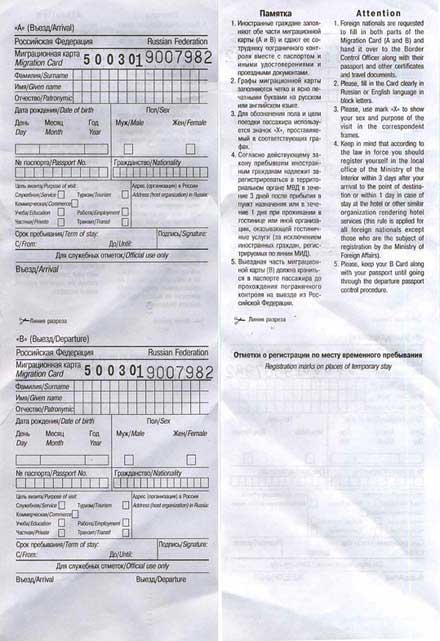
It is required to put in the migration card the personal data, terms of stay in Russia and purposes of visit and the prospective stay of residence. It is a must to fill in the name of the inviting company and the address of the inviting company (any good visa support company, including the ones presenting their services on WayToRussia.Net site will provide you with this information, at the stage of application).
If the information you provided on the migration card is different from what's written in your visa (especially, the inviting company's name), you might be questioned at the border.
When applying for visa support letter through WayToRussia.Net, that it is not WayToRussia.Net processing your order, but our partner company -- IntelService. Once you fill in the form, they'll send you their full address, which you'll need to specify in the migration card. Do not put "waytorussia.net" on the migration card -- we're an information resource, not a travel agency.
The migration card consists of two sections and the top portion is immediately collected by the passport/visa control officials, while the bottom part is collected when the person leaves the country to return home.
Thus, you now need to make sure that when arriving to Russia, you have the full name and address of the company that made your visa support letter (an invitation). This information is given on your visa support documents, please, copy it for further use.
You can see a sample of a migration card with English translation here (in MS Word or Adobe Acrobat format). Do not fill this in, all cards are numbered. You'll get yours on the border.
Foreign visitors will also be asked how long they intend to spend in Russia – and may be asked to show a proof – return tickets, for example. Their migration card will then be stamped with a specific departure date – according to this information! Even if the visa is good for a full 30 days, for example, but the migration card was issued for only 25 days, that person will need to leave Russia IN 25 DAYS or before the date on his or her migration card.
The "early interview" is going to be extremely important and may very well determine if the person is even admitted to visit Russia. However, most of the foreigners are admitted without any problems, if your answers are congruent with the information in the visa and visa support documents.
Need a Russian Visa? Order online, no reservation ties, ready in 24 hours:
click to load the russian visa application form
Work Permits for Russia
The law on the status of foreign citizens in Russian Federation introduces significant changes into the Russian employer - foreign employee relationship:
(1) The government will issue an annual quota for foreign workforce. The number is not defined clearly (530,000 for the year 2003), it will be formed depending on the local employers' requests. The government promises to allow as much as needed, but one can expect that this quota will be underestimated, because many foreigners are simply not declared properly. However, the law claims that if the quota is exhausted, it might be extended.
(2) To be able to legally work in Russian Federation, a foreign citizen needs a work permit, which should be obtained by his employer at the RF immigration officials.
Please, note, that a standard business visa allows any foreigner to come to Russia for short business meetings, conferences, exhibitions, negotiations, etc. A foreign citizen can not be permanently employed with such visa, at least offially (but it depends on any specific business..). If you are going to be officially employed with a company in Russia, this company needs to issue the invitation for you, and to obtain a work permit from immigration officials. If you're just coming for a meeting (or want a longer visa), then a standard business visa issued by a travel agency is enough.
In other words, the work permit is an official invitation from a business based in Russia, for a foreign citizen to have a permanent job with this business.
If a foreign citizen changes his job, he may keep the work permit obtained by his previous employer, if not less than 3 months left until the expiry date.
It is important to distinguish the "work permit" (which is a document that belongs to a foreign citizen) from the "permission to employ foreign citizens", that is obtained by any company to be able to legally employ foreign citizens.
(3) All employers, who need to hire a foreign citizen, now need to get a permission to employ foreign citizens (without exception).
(4) All foreign citizens, officially employed in Russia, will be registered in Russian immigration and tax officials by the employer.
There are certain categories of foreign citizens, who don't need a work permit:
(a) Temporary and permanent residents. (However, if you think it is a good way to get around the work permit rule, it's not so, because it's longer more complicated to get a permit of staying in Russia - see information in Temporary and Permanent Residence section below)
(b) Students, teachers. (Different rules apply to them - to be clarified with the inviting university or edudational institution)
(c) Dimplomats, representatives of international organisations (different rules apply).
If the work permit is not obtained, a foreign citizen who doesn't have a work permit may be fined and deported from Russia. The employer will also be fined, and might have additional administrative charges (e.g. inability to employ foreign citizens for a period of time).
The best and the most legal way is to officially get a work permit for yourself through the employer (note, that this employer should also have a permission to employ foreign citizens).
You may also become a temporary or permanent resident. This process is long and complicated, but that is certainly a possibility.
Another way is to arrange that a certain staff leasing company employs you and then leases you to the company you really want to work with. It is highly probably that a professional staff leasing company will already know the process of getting a work permit for a foreign citizen, and if this is done once, then, as the law states, you can change the employer easily, without losing your work permit
click to load the russian visa application form
Permanent Residency
The private invitation can be made in the local immigration office (OVIR), at the place where the person, who is inviting you permanently lives. The person who invites you, should fill in a special application form in OVIR and submit it along with a copy of your (the invited person's) passport, and a paid bank transfer. (Note, there are huge queues in OVIRs). It will take about 1 month or longer for OVIR to process this information, and after it is done, a "private invitation" will be issued. This invitation should be posted (not faxed - originals are required by the embassies!) to the person who's invited. Then the person who is invited should submit this invitation, along with the invitation, passport, photos, and other documents required to the Russian embassy, and his private visa will be issued.
The private visa can be valid for a period not longer than 3 months (the exact period is specified in the invitation), and is single-entry only.
After you arrived to Russia with such "private" visa, you should register at the place of residence of the person who invited you. For that there needs to be a proof that this person has the rights for this apartment (obtained in a local housing office), and a notarized letter, where the person states he/she doesn't mind you living in his apartment for a specific period of time (the form is standard - every notary knows it).
After you're registered, if you still want to become a temporary resident, you need to get a pile of documents. The requirements change all the time, so it's better to get an up-to-date list from OVIR. Generally, a foreign citizen will need his passport, private visa, information confirming the place of work / study, information that confirms the place of residence (should be issued by prefecture), information confirming a certain income, medical insurance. The Russian person, who is inviting the foreigner, should confirm the rights for the apartment, bring in all the same documents, confirming place of work / study, income, medical insurance etc. It's better to use a specialized agency's services to file all the documents before submitting them to OVIR. These agencies will not gather the documents for you, however, they know how to submit the documents that OVIR officials like it.
If everything is ok, you'll get the answer in about 1 to 3 months time.
However, the temporary residence is quite limited: a foreign citizen will have certain rights, and be able to enter Russian Federation, but in order to leave Russia, he/she will have to get a special "exit" visa from OVIR every time (it takes 2 to 4 weeks to get it)! So, imagine, you need to leave Russia fast, you can't do it, because you have to apply (queues), and then wait, and only then get a single-exit visa.
In other words, this process is not worth going through at the moment, unless you really need a temporary Russian residence. The rules are not easier for spouses as well...
The only good thing is that the rules may change soon, and become easier. We will monitor the situation, and as soon as there's a significant change, we'll update information in this section.
Need a Russian Visa? Order online, no reservation ties, ready in 24 hours:
click to load the russian visa application form
Russian Visa Laws
The Chapter 5 of this law (FL #114-FZ) lists the cases when a foreigner may be refused entry in Russia. Specifically Article 26 lists the cases when a foreigner may be (not necesserily will be!) refused the entry:
1) if he/she can't confirm that they'll have enough money for their whole trip in Russia;
2) if he/she broke the rules of crossing the Russian border (like carrying dope or guns, for example);
3) if he/she provided wrong information about the purpose of his trip (for example, you're getting a tourist visa to work in Russia - this is not lawful);
5) if he/she commited an administrative infringement in Russia more than twice in the past (for example, if you didn't register your visa, or were fined for not having a ticket in a train);
6) if he/she is a drug addict, or has an infection desease.
The Article 27 lists the cases when a foreigner must be refused the visa:
1) if it's necessary for the state security;
2) if he/she had comitted a crime in the RF (only during the first 5 years after the crime);
3) if he/she was deported out of Russia (only during the first 5 years after that);
4) if he/she didn't present the documents needed to apply for a Russian visa -- until these documents are presented;
5) if he/she couldn't confirm having enough funds to finance the trip, when crossing the Russian border;
Restricted Cities in Russia
Samara and Nizhny Novgorod. Crossing the border in the cities of Samara and Nizhnii Novgorod requires special vouchers. Processing time is one business day and the cost is $100. Please note that this applies ONLY to tourists flying DIRECTLY into these cities and going through passport control there. For those flying into Moscow and St. Petersburg and then traveling to Samara or Nizhnii Novgorod, regular invitations will suffice.
Volgograd, Astrakhan, Novosibirsk, Murmansk, Severodvinsk, Apatity, Moscow Region (Dubna, Obninsk, Korolev and other "science" towns which used to have restricted access in the Soviet times), also at Northen Caucasus: Rostov Region, Krasnodarsky Krai, Mineralnye Vody, Pyatigorsk, Krasnovodsk. If the first point of your entry is any of these cities, please make sure that you do all of the following:
1. Inform your visa support company that you're going to visit these cities, so that they add it to your itinerary on the visa support documents (voucher).
2. Have a voucher copy with you when going through passport control
3. Remain consistent with the visa information and when asked about the purpose of visit and a place of stay, to indicate TOURISM and a hotel entered on the voucher.
4. If you travel to these cities, we strongly recommend you to to stay at a hotel the whole period you're in that city, but if you're visiting friends or relatives – have them find a way to register you with local migration authorities.
Here's a list of the cities you cannot enter with an invitation issued by a Moscow or St. Petersburg travel agency. In order to enter, you have to seek a special authorization from the local migration authorities. Yakutia - Sakha Republic, Norilsk, Sakhalin, Kamchatka, North Ossetia (Vladikavkaz), Chechnya, Nalchik, Dagestan.
Need a Russian Visa? Order online, no reservation ties, ready in 24 hours:
click to load the russian visa application form
Know Your Rights - Russian Registration Laws.
Article 20-2 claims that the children under 18, who entered Russian Federation with their parents, or with one of the parents, should be registered together with the parent. The order of registration is defined in the Article 21.
Specifically, the Article 23-3 says that a foreign citizen should register at the place of his arrival in Russian Federation. (e.g. if you arrived in Irkutsk, and plan to stay there for longer than 3 days, you should register, even if you're going elsewhere after).
The Article 23-3 also says that if a foreign citizen changes the place of his stay, he should register in the new place during the first three working days after his arrival. (e.g. if you came to St. Petersburg for 4 days, and then plan to stay in Moscow for another 5 days, you should register twice - once in St. Petersburg, then in Moscow.)
Article 21-6 claims that if a foreign citizen lost his documents during his stay in Russian Federation, he should not register. In this case, he should leave Russia not later than 10 days (including holidays) after he obtained the temporary documents.
According to Article 22 the foreigners who enter Russian Federation with diplomatic purpose, should be registered by the Russian Ministry of Foreign affairs. (If that is your case, we advise you to contact the organization you're visiting in Russia to learn in detail about the registration process, as it is different) The documents needed for registration are listed in the Article 23:
1) a migration card with a stamp of passport control at the border;
2) passport or an identity document (it should be passport, because there's visa in the passport). According to Article 24, a hotel must register a foreign citizen who is staying there, and forward all the information to the Russian immigration officials. When a foreigner leaves the hotel, the hotel must forward the date of leaving to immigration officials again. The categories of foreigners who should not be registered are listed in the Article 25: 1) president of a state, head of international delegation, members of foreign government organisations, and members of their families;
2) (sic) foreign citizens, who arrived to Russia for the period not longer than 3 days;
3) sailors, pilots; 4 and 5 lists other categories. Please, note, that if you were fined twice for breaching the Russian registration rules by the authorities, this information will be entered in the database and there's a high chance you won't be able to get a Russian visa for 5 years.
Disclaimer: We are not lawyers and this is not a legal advice, please use it at your own risk and consult professional lawyers before making decisions. We are not liable or responsible for any consequences of the actions you take based on this information.
Need a Russian Visa? Order online, no reservation ties, ready in 24 hours:
click to load the russian visa application form
Most Recent Articles:

How to Get a Russian Visa: Step by Step Guide

Russian Visa Application Form
