WayToRussia.Net Guide to Russia
 
    Made by Travelers from Russia for Travelers Worldwide Guide to RussiaTravel ServicesOur Team
    >> WayToRussia.Net / Destinations / Novgorod / Sightseeing
  novgorod guide
  about the city
history
transport
practicalities
eating out
accommodation
going out
sightseeing
map of novgorod
 
  guide to russia
  what is russia
practicalities
transportation
russian visa
expat guide
destinations
talk lounge
life in russia
 
  travel services
  apartment rent
accommodation
airline tickets
train tickets
visa support 
transfer / taxi
tours
extra services
 
  our team
 

Sightseeing in Novgorod.

contents: sofiiskaya storona / detinetssofiiskaya storona / outside detinetstorgovaya storona / yaroslav's courttorgovaya storona


We designed a nice tour to Novgorod architecture and history, with descriptions of the main sights for you. We listed the sights in the special order, and they are listed at the same order on the map (you can open a map of Novgorod). This tour'll take you around 4 hours walking (without the outside of Novgorod).


Novgorod is divided into two parts -"storony" by the river Volkhov (Волхов). These parts are: Sofiyskaya Storona - Софийская Сторона (called after the church of Sofia in the Kremlin) and Torgovaya Storona - Торговая Сторона (called after 'torg' which
means trade place - where there were the main warehouses and markets).

novgorod / sofiiskaya storona / detinets


Detinets.
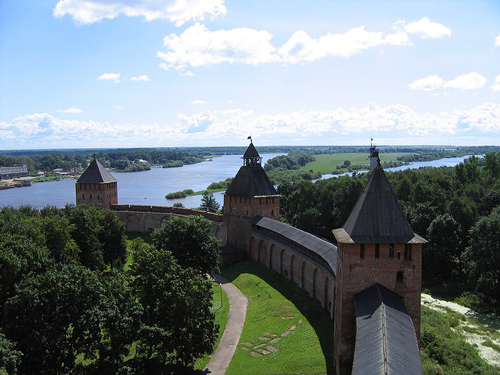
Detinets (Детинец) is Novgorod Kremlin. It is a brick fortress with 9 towers. The first walls of Detinets were built in the 10th century, later it was rebuilt many times. In the 14th century the brick walls were constructed and they're still there.
Nowadays Detinets is a kind of park with nice buildings inside.
I guess, you will first see Detinets from the riverside, but I advise you to walk around it, the backside is far more interesting and looks more realistic, like a real antique castle.
Map: Kremlin


Cathedral of ST. Sofia.
There is a famous church inside the Detinets - the Cathedral of St. Sofia (Софийский Собор) - the main church of northern Russia.
Sofia Novgorodskaya in Novgorod Detinets
Local architects built it in the 1050. It's a symbol of the town and one of the oldest stone buildings in Russia. The height of the church is more than 38 meters. An iron dove sits on the cross of the cathedral. There's a myth, that if the dove ever happens to fly away, it will mark the last day of Novgorod.
Besides its religious functions, St. Sofia also used to be the place where the treasury of Novgorod was kept, there were special hiding places on the second floor for gold.Local architects built it in the 1050. It's a symbol of the town and one of the oldest stone buildings in Russia. The height of the church is more than 38 meters. An iron dove sits on the cross of the cathedral. There's a myth, that if the dove ever happens to fly away, it will mark the last day of Novgorod.
Besides its religious functions, St. Sofia also used to be the place where the treasury of Novgorod was kept, there were special hiding places on the second floor for gold.
Daily preach services take part in St. Sofia around 19.00 in the evenings. To enter the church at the time of the service men should wear trousers and long-sleeve shirt, women should also cover their heads with something. Map: 1


Granovitaya Palata (Chamber of Facets).
You will easily find it: it is the only building in the Detinets built in Gothic style. German architects built it in 1443 as a part of the Prince Palace. The main court of Novgorod had its sessions in Granovitaya Palata.
Once, Tsar Ivan the Terrible attacked the city and sacked it. Most of the nobles hid their money and the Tsar Ivan couldn't find it, so he invited the best people of Novgorod to the feast in Granovitaya palata and killed everybody who refused to give him their money. So it is a kind of cursed place.
Nowadays there is a museum of Russian arts and crafts in the building, with a nice collection of icons from the north regions.
Opened: 10.00 - 17.00, day off wednesday and the last friday of the month. Map: 2


Monument "1000 years of Russia".
A rich and heavy monument dedicated to the millenium of Russia: it's the second most popular sight in Novgorod.
The monument "1000 Years of Russia", Novgorod
The first legendary prince of Russia -- Rurik began to rule in 862. So, in 1862, the Russian emperor Alexander II decided to build a monument to celebrate the 1000 years of Russia. There was a contest and the young Russian architect Mikeshin won. In 1867 the monument was opened.
It has the form of a bell with many bronze figures all around it. There are the 128 figures of the famous Russians, who were chosen by the emperor Alexander II himself. The monument is crowned by a cross - the symbol of the orthodox religion in Russia, with an angel on it and a woman (who symbolises Russia) in a traditional dress.
There are several groups in the monument: founders of Russia, the first rulers, Romanov family, authors and artists, enlighteners, officials, generals, and war heroes.
Map: 3


Museum of History and Art.
This museum has a really good collection of early icons, wood crafts, and birchen manuscripts.
Opened: 10.00-18.00, day off is Monday. Map: 4

novgorod / sofiiskaya storona / outside detinets


Trinity Church.
It was built by merchants in the 14th century. The upper part was completely rebuilt in the 19th century.
Directions: After you exit the Kremlin, turn right, walk staight to the Bolshaya St. Peterburgskaya ulitsa. Go straight along this street and in 10 minutes, there will be this church on your left. Map: 5


Church of Nikolai Bely.
Built in the year 1313. Once it was a part of the monastery, but nowadays it's a detached building.
Directions: From the trinity church go to the river, in one block on your left there will be this church. Map: 6


Church of Peter and Paul.
Built in the
Peter and Paul Church, Novgorod
year 1406. Nice example of the typical architecture of the 15th century. Built in bricks and limestone. (see the photo on the right).
Directions: It is just in front of the Church of Nikolay Bely. Map: 7


novgorod / torgovaya storona / yaroslav's court


Yaroslav's Court.
(Yaroslavovo Dvorishche - Ярославово Дворище).
Yaroslav's Court, Novgorod
The Yaroslav's court is located on Torgovaya Side - on the opposite side of the Kremlin-Detinets. This was the economical and political center of the ancient town of Novgorod. It is called so after the palace of Yaroslav, which is situated at this place.
Close to Yaroslav's Court, there's a territory called "Torg", that's where the merchants from all over Europe made their deals, and had their offices.
Map: 8

There are six churches in Yaroslavovo Dvorishche and a tower (it was a gate tower for the court). It's a nice green area with many masterpieces of Russian architecture gathered at one place. If you have some time and don't want to look at all these churches in the town you can just come here and in one hour you will see all the best of Novgorod.


Inside the Court / The Cathedral of ST. Nikolai.
The oldest building
The St. Nikolai Cathedral
in the court, built in the 1113. This is a big 5-dome cathedral, and was built for the best people of the town of Novgorod. (see the photo on the right).
Map: 9


novgorod / torgovaya storona


Church of SPASA-NA-ILIENE.
(Tserkov Spasa-na-Iliene - Церковь спаса-на-ильине). Built in the 1374, this church is famous because of the frescos inside. Feofan Grek - one of the most famous Russian icon painters - made these frescos. The frescos are in bad condition, but you can find some good
images at the north-west part of the church.
Directions: If you will cross the river from the Sophiskaya storona to the Torgovaya, go straight along Iliana street, and in 4 blocks there will be this church on your left. Open: daily, Mon is day off, 10.00-15.00. Map: 10


Znamenski Cathedral.
It is situated right in front of the Church of Spasa-na-Iline. This cathedral of 17th century is a typical building of Moscow architecture school. In the 17th century Novgorod was already part of Moscow kingdom, so the new architecture traditions were used.
Map: 11


Church of ST Teodor Solunski on the Spring.
You won't see the spring, it was filled up during the construction of the Moscow - St. Petersburg railroad. This nice church was built in the 14th century, it is poorly decorated and simple which makes it very beautiful. There are Interesting frescos inside.
Directions: This church is situated in the Feodorovsky Ruchey (Феодоровский Ручей) prospect, this street is parallel to the Iliana.
Map: 12


novgorod / outside novgorod


Yuriev Monastery and Museum of Wooden Architecture (Vitoslavitsy).
Yurev monastery (Юрьев Монастырь) is a Russian monastery with a dome-cathedral, several buildings,
Yuriev's Monastery
and a wall around it.
Nearby, approximately 1 kilometer apart there is Vitoslavitsy (Витославицы) - The Museum of Wooden Architecture.
They collected here the typical wooden buildings of the middle centuries. The churches, houses, and warhouses were brought here from all over the area of Novgorod and the new small town was set up.
Directions: Bus #7, this is the only bus to get there. You can take it at Sophiyskaya ploshad, you need the direction of "Ilmen" lake, the stop is called "Yureev monastery" (it will take about 15-20 min to get there). You can also take a taxi or a car for 30-50 roubles ($1-$1.7). Open: 9.00-18.00, day off Wednesday.


Visa Support

Online Russian visa support. Short- and long-term, multiple entry, flexibility, registration. From $30.
Apply now...
 
  Privacy Policy | Terms of Use
© 2003 Dmitri Paranyushkin / WayToRussia.Net. All rights reserved.
Ask Us a Question
Feedback